
Sam’s Club: New Data Sets and AI Chatbot
Overview
This case study outlines a critical 0-to-1 project where my team built a net-new, financial forecasting feature within Walmart's Intelligent Business Growth (IBG) platform. IBG is Walmart and Sam’s Club’s internal financial operations tool; it’s designed for connected business planning.
My role
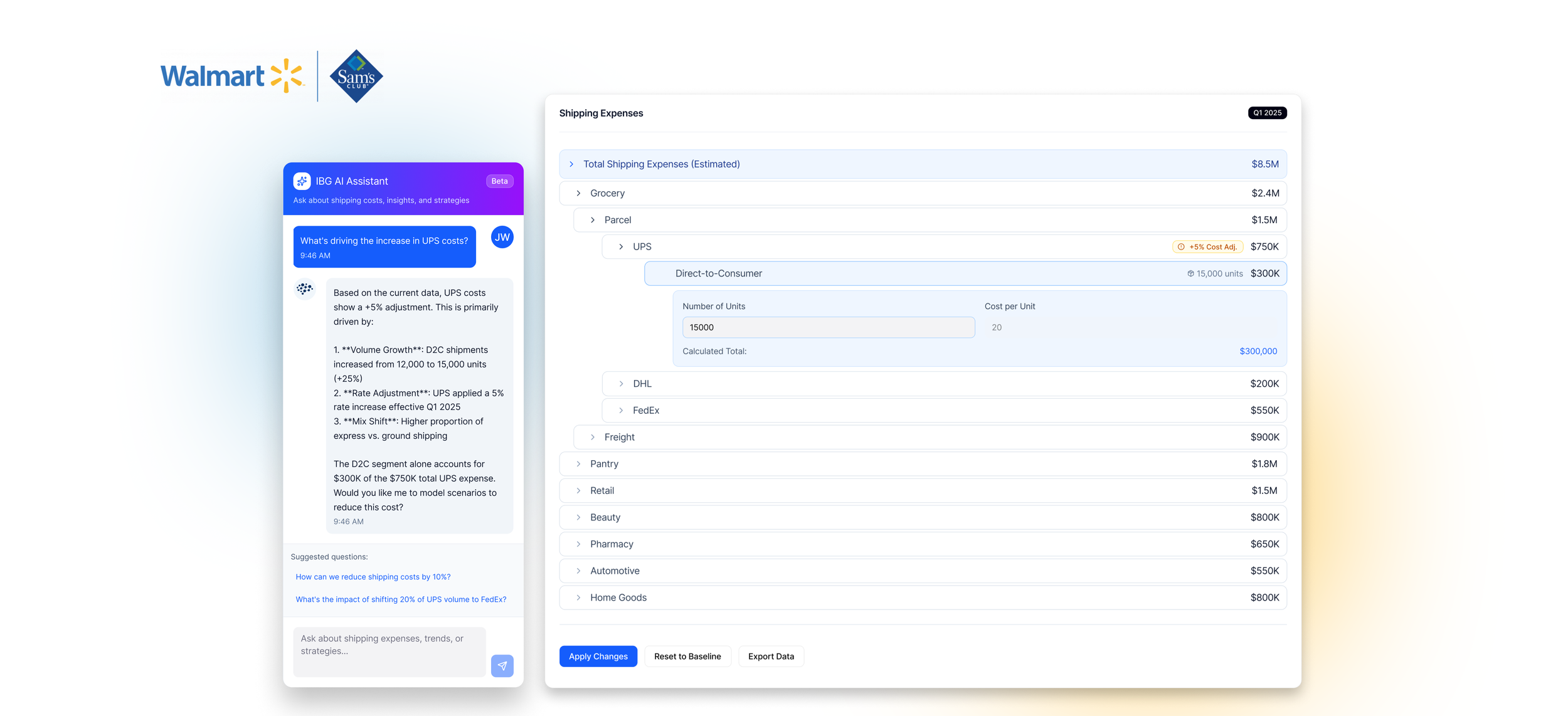
I led the product design for a new feature: a financial modeling tool designed to automatically calculate shipping expenses and generate accurate forecasts. The result? My team delivered the high-quality, unified data Sam's Club senior leadership needed to execute multi-million dollar strategic planning and forecasting.
Data Visualization
Forecasting Automation
Gen AI Integration
-
Key Contributions
Role: Lead Product Designer
✓ I transformed a highly fragmented, manual process into a centralized, efficient forecasting platform.
✓ I eliminated tedious data manipulation, allowing Merch and Finance teams to shift focus from data gathering to high-value strategic analysis.
✓ I drove design system maturation by creating and contributing the net-new "Driver Tree" component to the internal IBG design library for future reuse across the platform.
✓ I led the design of an innovative AI Chatbot, driving a collaborative effort with ML, brand, and visual design teams to shape its intelligent responses, friendly voice, and seamless integration into IBG.
✓ I maintained stakeholder alignment across Product, Engineering, Finance and Merchandising, communicating complex design decisions to maintain project traction and speed.
-
Problem
Sam’s Club Merchandising and Finance teams were locked in an inefficient workflow, spending excessive time running calculations in Excel and manually migrating financial data across a fragmented landscape of tools including PBC, OneStream, PowerBI, BigQuery and Green Mountain.
This manual process often resulted in inaccurate, untimely financial forecasts and hindered senior leadership’s ability to make agile business decisions.
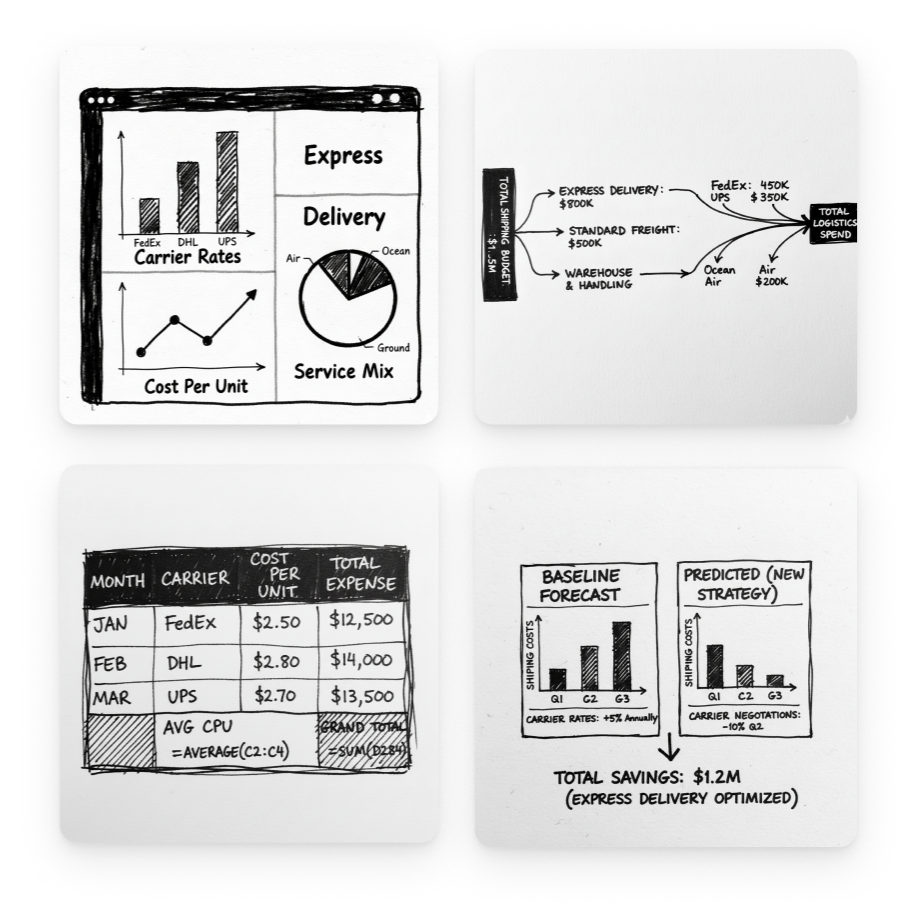
Finding the Right Data Model
I explored three directions before deciding on a driver tree:
❌ Enhanced table view — This was fast to build and familiar to users, but it didn't solve the core problem of seeing relationships between data sets.
❌ Dashboard with drill-down panels — This added hierarchy but forced users to navigate linearly, one level at a time.
✅ Horizontal node tree — a spatial layout where parent metrics and their child components are visible simultaneously.
I chose the driver tree based on a key insight from early whiteboarding: the question analysts were actually trying to answer was "which component is driving the change?" That's a structural question, so I chose a structural answer.
The Solution
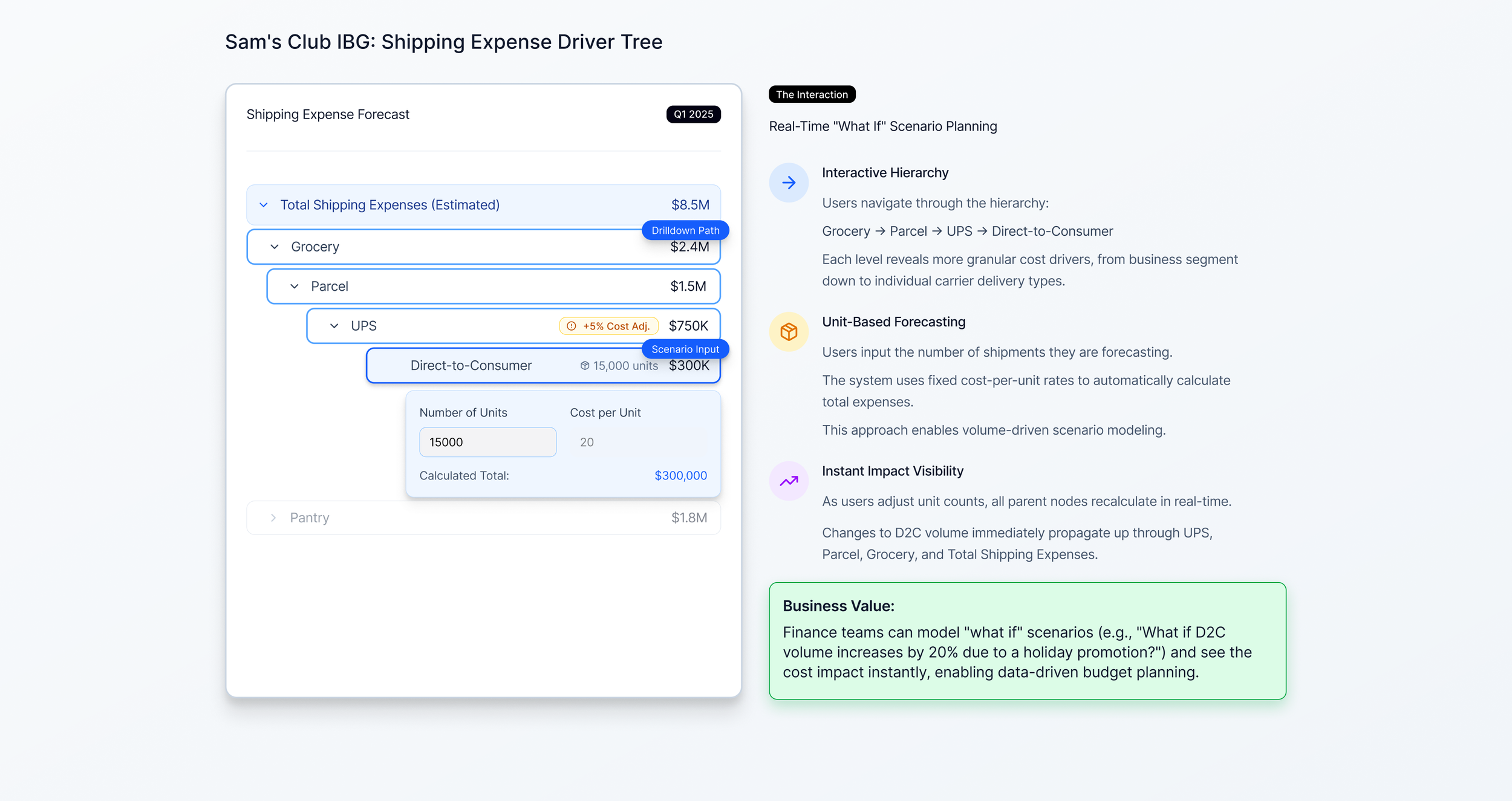
I designed a net-new feature for calculating and forecasting shipping expenses. This solution revolves around a driver tree structure with nodes, parents, and children to visually represent the hierarchy and interdependencies of our expenses. This was the design move that transformed static data into an interactive financial model.
Custom Components for Complex Data
I created custom-built hierarchical input components for real-time financial scenario modeling. The new driver tree features collapsible drill-down structure with live calculation updates.
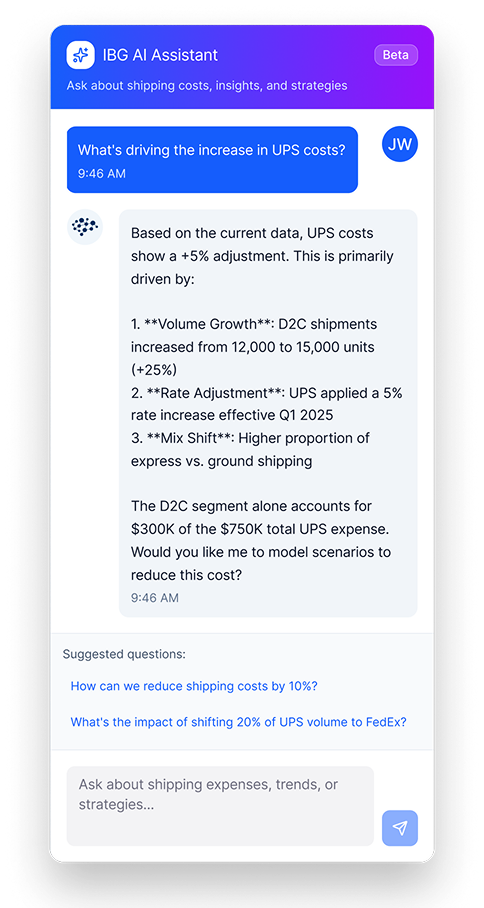
An AI-powered chatbot for natural language-based insights
What it was
A piloted beta test, leveraging Generative AI for data access.
How it worked
It sat directly beside the Driver Tree, accessing the exact same data source, refreshing simultaneously.
The UX
Users could bypass complex workflows and ask simple, natural language questions, like: 'What was the shipping expense variance for Express Delivery in DFC last month?'
Impact
-
3,900
Decrease: Manual Data Entry
Over 3,900 hours saved annually in manual data gathering time.
-
15
Core Variables
Integrated 15+ core shipping variables into the forecasting model.
-
100%
Target Adoption
100% target adoption achieved within the core Finance and Merchandising teams.